
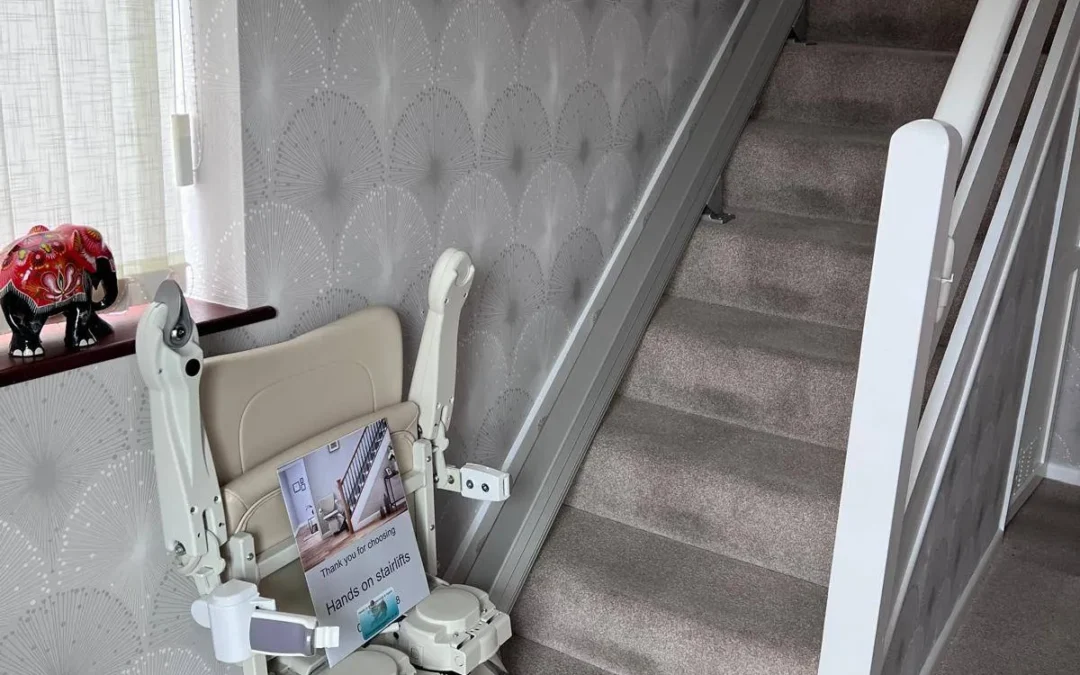
One of the very first questions homeowners ask us during a home survey across Bristol and Somerset is: “Will fitting a stairlift ruin my wallpaper or damage my walls?”
It is completely understandable to worry—especially if you have recently decorated your hallway or live in an older Victorian or Edwardian property with delicate plasterwork.
The short answer is no. A properly fitted stairlift does not attach to your walls at all.
Here is a straightforward look at how our engineers actually fit a stairlift, how long it takes, and what your stairs will look like once we pack up our tools.
1. Fitted to Your Stair Treads — Never Your Walls
Many people assume a heavy stairlift rail has to be bolted into a brick wall to support someone’s weight. In reality, modern straight and curved stairlift tracks are supported by sturdy metal feet that screw directly onto your wooden stair treads (the flat steps you walk on).
Because the track rests on the stairs themselves:
-
Zero wall drilling: Your plasterwork, skirting boards, and wallpaper remain completely untouched.
-
Works on stud walls: Even if your staircase runs alongside a hollow plasterboard stud wall, a stairlift can still be fitted safely because the wall carries none of the weight.
-
Carpet-friendly: If you have fitted stair carpets, our engineers carefully secure the brackets through the pile without ripping or fraying the surrounding fabric.
2. How Long Does Stairlift Installation Take?
Because no structural building work or wall strengthening is needed, stairlift installation is much quicker and cleaner than most families expect:
-
Straight stairlifts: Usually fitted and tested in 2 to 3 hours.
-
Curved stairlifts: Made to measure for staircases with turns or landings, typically fitted in 3 to 5 hours.
We bring dust sheets to protect your hallway, vacuum up any tiny wood shavings from the tread fixings, and walk you through every button and safety sensor before we leave.
3. Will the Rest of the Family Still Have Room on the Stairs?
Narrow hallways are very common in homes across Bristol, Bath, Clevedon, and Weston-super-Mare. When your stairlift is not in use, the seat, armrests, and footrest fold neatly upright against the rail—leaving plenty of clear space for everyone else in the house to walk up and down comfortably.
If you have a doorway right at the bottom of the stairs, we can also fit a hinged track (either manual or powered) that folds up neatly out of the way so the bottom step is never blocked.
4. What Happens If the Stairlift Is Ever Removed?
Whether you opt for a short-term stairlift rental while recovering from an operation or eventually no longer need your lift, removal is just as clean as installation.
When our engineers carry out a stairlift removal, the brackets are simply unscrewed from the stair treads. On carpeted stairs, brushing the carpet pile over the tiny screw holes usually makes them vanish completely.
Have Questions About Your Staircase? Speak to a Local Engineer
If you are unsure whether a stairlift will suit your stairs, you don’t need a three-hour sales pitch to find out. At Hands On Stairlifts, we are a small, independent team rated 5★ on Google across Bristol & Somerset.
One of our experienced engineers can pop out for a free, 20-minute look at your staircase, answer your questions honestly, and leave you with a clear, fixed written quote—with zero obligation.
Call our local team on 0117 235 6653 or get in touch via our Contact page to book a convenient time.
Recent Comments